> Presentation Portfolio Site
// Created at: 09-08-2026
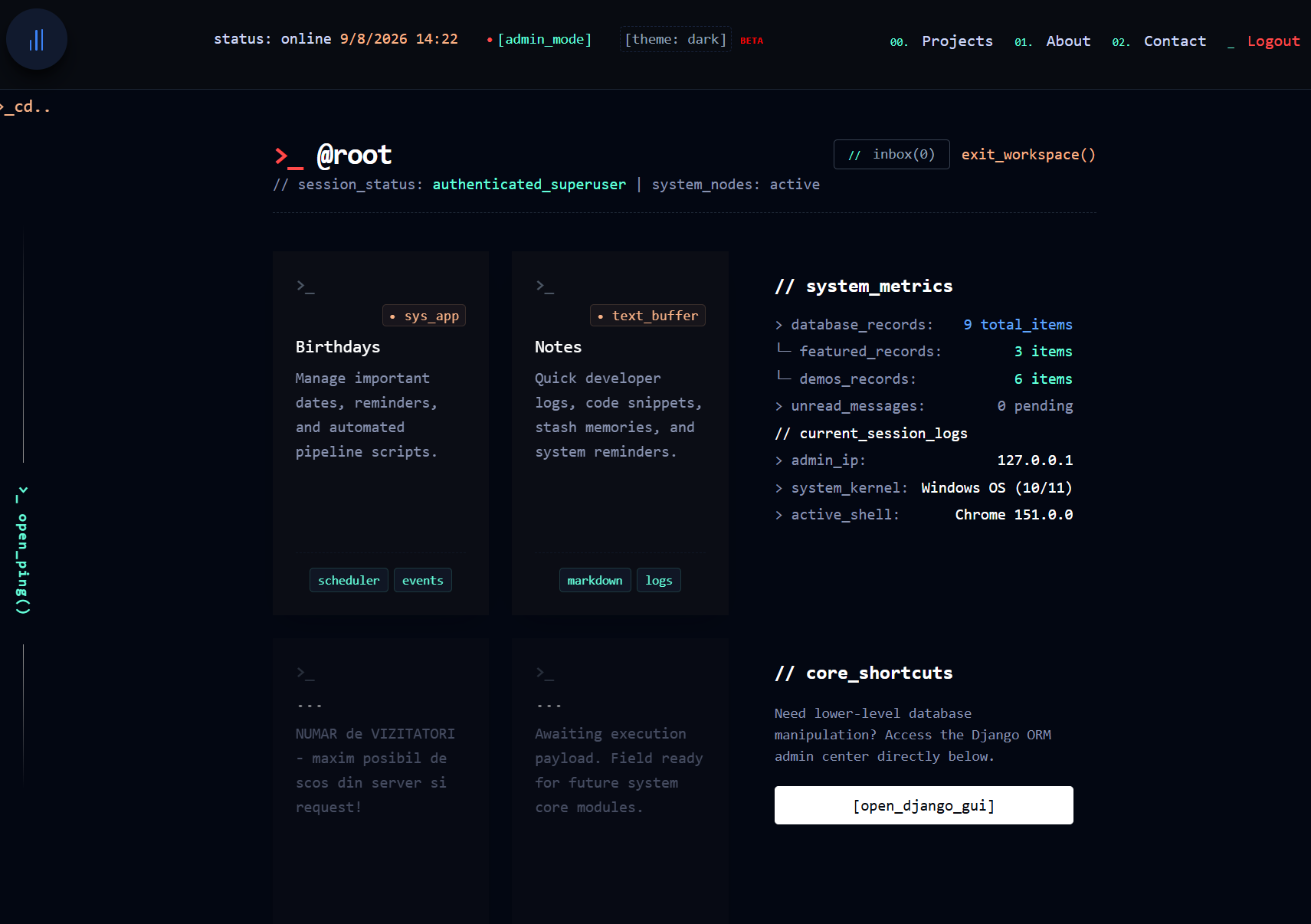
[Project Overview]
A high-performance, monolithic portfolio ecosystem engineered with Python 3.12 and Django 5.x. The project completely dismantles the need for traditional third-party admin panels by injecting atomic CRUD operations natively into the DOM layers. The entire architecture is wrapped behind defensive, role-based guard clauses that throw native HTTP 403 exceptions upon unauthorized access, creating an ironclad, self-contained, and easily maintainable digital environment. // architectural_overview_and_intent A meta-programmatic engineering of a bespoke monolithic personal portfolio, designed as a highly optimized, dual-application ecosystem (projects and users). The core engine completely bypasses the requirement for traditional, rigid third-party administration backends for daily management. Instead, atomic CRUD operations (create, update, delete) are injected natively into the public DOM layers (projects.html, about.html), strictly guarded at the server kernel level by cryptographic session tokens and explicit superuser validation checks. // security_layer : role_based_guards_and_exception_handling Isolation of critical operational endpoints is governed by an array of defensive software guards. Beyond classical session checking via @login_required, the central diagnostics panel (workspace-control/) utilizes a predicate-backed security wrapper (is_superuser_check) mapped across Django’s @user_passes_test decorator. Rather than executing a standard redirection response (which reveals private endpoints to URL enumeration vectors), the pipeline explicitly raises a native PermissionDenied exception. This delegates execution to the core framework to return a clean, uninformative HTTP 403 Forbidden state, effectively masking system topology from unauthorized agents. // database_performance : bulk_state_modifiers_and_the_n_plus_1_fix To maintain rendering times within linear O(1) constraints, the system deploys proactive performance adjustments across the Object-Relational Mapper (ORM). When loading the core project index matrix, a naive implementation would execute separate queries for each item's Many-to-Many tags, triggering a performance-killing O(N) N+1 query vulnerability. The application resolves this by forcing a cache-buffered join in memory via .prefetch_related('tags'). Furthermore, data mutations within the inbox stream leverage bulk state modifiers: when accessing the dashboard, unread payloads are not iterated sequentially. The engine fires an atomic SQL UPDATE statement through .filter(is_read=False).update(is_read=True), condensing state transitions into a single database trip regardless of transaction volume. // data_pipeline : asymmetric_nested_formset_validation The creation and update pipelines execute an asymmetric data validation architecture to handle complex, cascading relationships (Project -> RabbitHoleLayer -> RabbitHoleSection). Standard nested formsets crash during validation if intermediate foreign keys do not exist or if fields are partially emitted. The system intercepts the incoming POST stream and dynamically inspects field state via any(cleaned_data.values()). If an optional deep-dive documentation layer (Rabbit Hole) is omitted by the user, the backend drops structural validation requirements for those specific nodes. This bypasses rigid database NOT NULL constraints dynamically, enabling the rapid initialization of minimal projects while preserving strict relational database guarantees for complex data sets.
[_Case Study]
High-Level Macro Architecture (ASCII Diagram)
This blueprint illustrates the lifecycle of an incoming request, demonstrating how it triggers concurrent passive context processors before passing through defensive security guards to access application-specific resources
+---------------------------------------------------------------------------------------+

|                                    INCOMING REQUEST                                   |
|                          (Client HTTP Payload & Token Session)                        |
+---------------------------------------------------------------------------------------+
                                             |
       +-------------------------------------+-------------------------------------+
       v                                                                           v
+-------------------------------------------+               +--------------------------------------------+

|      CONTEXT PROCESSOR: GLOBAL PROFILE    |               |       CONTEXT PROCESSOR: TELEMETRY         |
|  Pre-loads: Profile, Unread Messages,     |               |  Parses headers: IP (via X-Forwarded-For)  |
|  Analytical Projects Counters  [O(1)]     |               |  Device Introspection, OS & Language [O(1)]|
+-------------------------------------------+               +--------------------------------------------+
                                             |
                                             v
+---------------------------------------------------------------------------------------+

|                                  ROUTING GATEWAY & GUARDS                             |
|    Intercepts URL endpoints & enforces strict security wrappers across environments   |
+---------------------------------------------------------------------------------------+

          |                                                                   |
          | [@login_required Guard]                                           | [@user_passes_test -> 403]
          v                                                                   v
+-------------------------------------------+               +-------------------------------------------+

|             APPLICATION: PROJECTS         |               |              APPLICATION: USERS           |
|  - Asymmetric Nested Formsets Pipeline    |               |  - Bulk Query State Modifiers             |
|  - Atomic Tag Tokenizer (M2M Pipe)        |               |    [unread_messages.update(is_read=True)] |
|  - Optimized Evaluation Querysets [O(1)]  |               |  - Protected Root Workspace Controls      |
+-------------------------------------------+               +-------------------------------------------+

          |                                                                   |
          +-------------------------------------+-------------------------------------+
                                                v
+---------------------------------------------------------------------------------------+

|                                      PERSISTENCE LAYER                                |
|           PostgreSQL / SQLite Normalization via Django QuerySet Cache Buffering       |
+---------------------------------------------------------------------------------------+
Database Entity-Relationship Diagram (ERD)
The relational persistence model spans both apps, demonstrating how normalized relational database structures interface through explicit cascading constraints and asymmetric optional documentation layers
APPLICATION: USERS                                          APPLICATION: PROJECTS
========================                                    ===========================
+------------------------+

|   django.contrib.auth  |
|      (User Model)      |
+------------------------+
            |
            | (OneToOneField - CASCADE)
            v
+------------------------+                                  +------------------------+

|      users.Profile     |                                  |    projects.Project    |
| ---------------------- |                                  | ---------------------- |
|  id (UUID PK)          |                                  |  id (UUID PK)          |
|  subtitle              |                                  |  title                 |
|  bio / profile_image   |                                  |  description           |
|  social_links / tel    |                                  |  project_type (choice) |
+------------------------+                                  |  vote_score            |

      |              |                                      +------------------------+
      | (1:N)        | (1:N)                                     |    |    |          ^
      v              v                                  (1:N)    |    |    | (M:M)    | (1:N)
+-----------+  +-----------+                            +--------+    |    |          |

|users.Skill|  |users.Msg  |                            v             |    |          |
| --------- |  | --------- |                    +---------------+     |    |          |
| id (UUID) |  | id (UUID) |                    |  ProjectImage |     |    |          |
| brand     |  | name      |                    | ------------- |     |    |          |
| rank      |  | email     |                    |  id (UUID PK) |     |    |          |
| category  |  | subject   |                    |  image / order|     |    |          |
+-----------+  | body      |                    +---------------+     |    |          |

               | is_read   |                                          |    |          |
               +-----------+                                  (1:N)   v    |          |
                                                        +---------------+  |          |

                                                        | ProjectSection|  |          |
                                                        | ------------- |  |          |
                                                        | id (UUID PK)  |  |          |
                                                        | section_title |  |          |
                                                        | section_code  |  |          |
                                                        | section_text  |  |          |
                                                        +---------------+  |          |
                                                                           v          |
                                                        +---------------+             |

                                                        |  projects.Tag |             |
                                                        | ------------- |             |
                                                        |  id (UUID PK) |             |
                                                        |  tag_name     |             |
                                                        +---------------+             |
                                                                                      |
                                                              (Asymmetric 1:1 / 1:N)  |
                                                                                      v
                                                                        +-----------------------+

                                                                        |   RabbitHoleLayer     |
                                                                        | --------------------- |
                                                                        |  id (UUID PK)         |
                                                                        |  title / description  |
                                                                        |  featured_image       |
                                                                        +-----------------------+
                                                                                    |
                                                                                    | (1:N Nested Tabular)
                                                                                    v
                                                                        +-----------------------+

                                                                        |   RabbitHoleSection   |
                                                                        | --------------------- |
                                                                        |  id (UUID PK)         |
                                                                        |  section_title        |
                                                                        |  section_code / text  |
                                                                        +-----------------------+