> Arcade Engine: Space Invaders
// Created at: 31-07-2026
[Project Overview]
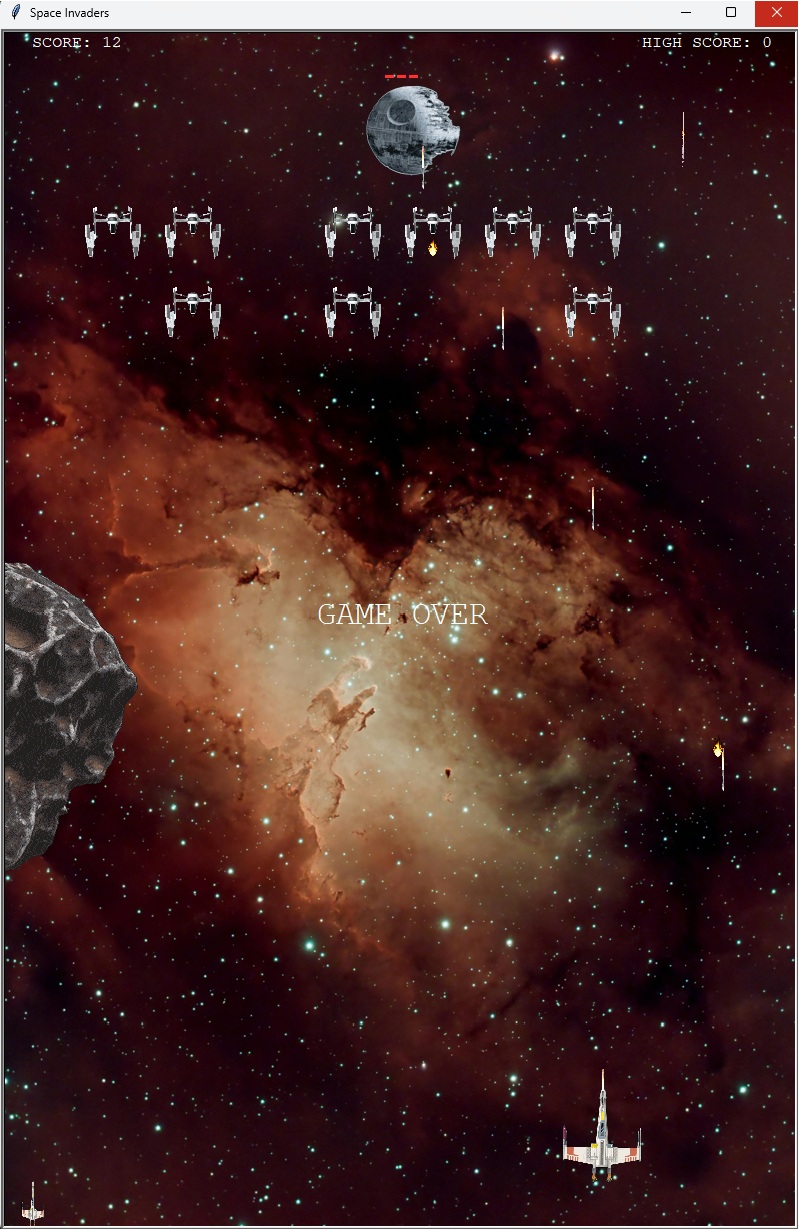
This engine is a highly structured, Object-Oriented implementation of a retro space arcade environment built from the ground up using Python and the native Turtle Graphics graphics canvas library. Moving away from messy, unorganized script layouts, the project features clean component separation by breaking distinct systems—such as player control, vector-shifting alien fleets, dynamic hazard generators, score trackers, and recursive phase boss engines—into individual modules.The main loop handles frame state transformations, non-blocking asynchronous user interaction capturing, dynamic state shifts, and persistent record logging, making it an excellent demonstration of solid software design principles. A responsive desktop retro-arcade engine built in Python 3.12 using Turtle Graphics that implements object-oriented systems separation to render dynamic gameplay states. The software utilizes a custom frame-buffer setup (tracer(0)) to ensure stutter-free rendering, handles user controls via non-blocking asynchronous event mapping listeners, and calculates collisions cleanly across individual modules using strict mathematical distance vector limits. Featuring an advanced multi-phase system that activates an opcional flagship boss after the base fleet drops below threshold counts, the application showcases highly modular design and permanent file-storage handling.
[_Case Study]
Technical curiosity
When developing this arcade engine, an unexpected structural anomaly emerged: if a player destroyed any enemy ship while the fleet was moving across the screen, the entire formation would later become physically distorted, miss the boundary thresholds, and slide completely off the canvas. The fleet would only bounce back once the absolute last remaining ship in the fleet array hit the margin. The core problem stems from mutating a list in-place while iterating over it sequentially. When .remove() is called, Python immediately shifts all subsequent elements one slot to the left to fill the empty allocation space. However, the active for loop cursor keeps moving forward sequentially to the next index. This causes the loop to completely skip the ship right next to the deleted one for that single frame. That skipped ship missed its position update, causing it to permanently lag behind by MOVE_DISTANCE (5 pixels). Because this entire sequence is nested inside the infinite heartbeat of the 'while self.game_is_on:' loop in main.py, the error compounded exponentially on every tick. The Solution: De-coupling State with the Snapshot Pattern To stop the infinite while loop from amplifying these shifting indices, the code introduces a variant of the Snapshot Design Pattern, isolating the boundary evaluation check into short-lived, immutable memory captures: newlst_right = [i for i in self.alien_ships if i.xcor() > 350] newlst_left = [i for i in self.alien_ships if i.xcor() < -350] By generating newlst_right and newlst_left via list comprehensions, the code captures an instance snapshot of the ships' physical locations on the canvas, completely independent of their index positions in the master self.alien_ships collection. Even if a prior frame skip caused a ship to lag behind or drift out of formation, its spatial coordinates are caught by the snapshot list, forcing bounce_x() to execute reliably and keeping the entire fleet safely inside the screen boundaries. An advanced operational nuance inside the dynamic boundary handler is the explicit invocation of 'newlst_right.clear()' immediately following the vector inversion call. By explicitly executing '.clear()' on the temporary array inside the initial valid loop step, the engine performs a high-speed execution short-circuit. It purges remaining reference pointers instantly, halting the iteration process before redundant balance flips occur, ensuring that fleet trajectory changes exactly once per tick loop.
def move_fleet(self):
        for ship in self.alien_ships:
            ship.goto(x=ship.xcor() + self.x_move, y=ship.ycor())

        newlst_right = [i for i in self.alien_ships if i.xcor() > 350]
        newlst_left = [i for i in self.alien_ships if i.xcor() < -350]

        for ship in newlst_right:
            if ship.xcor() > 350:
                self.bounce_x()
                newlst_right.clear()

        for ship in newlst_left:
            if ship.xcor() < -350:
                self.bounce_x()
                newlst_left.clear()